
Bringing your bike to the French Riviera made easy
TL;DR:
Traveling cyclists arriving at Nice Côte d’Azur Airport can easily transport and reassemble their bikes to enjoy iconic Riviera routes with proper preparation. Selecting reinforced bike boxes, booking packing services, and arranging private transfers in advance ensure smooth logistics and optimal riding experiences. Proper planning and local services transform the region into an accessible cycling paradise for enthusiasts of all levels.
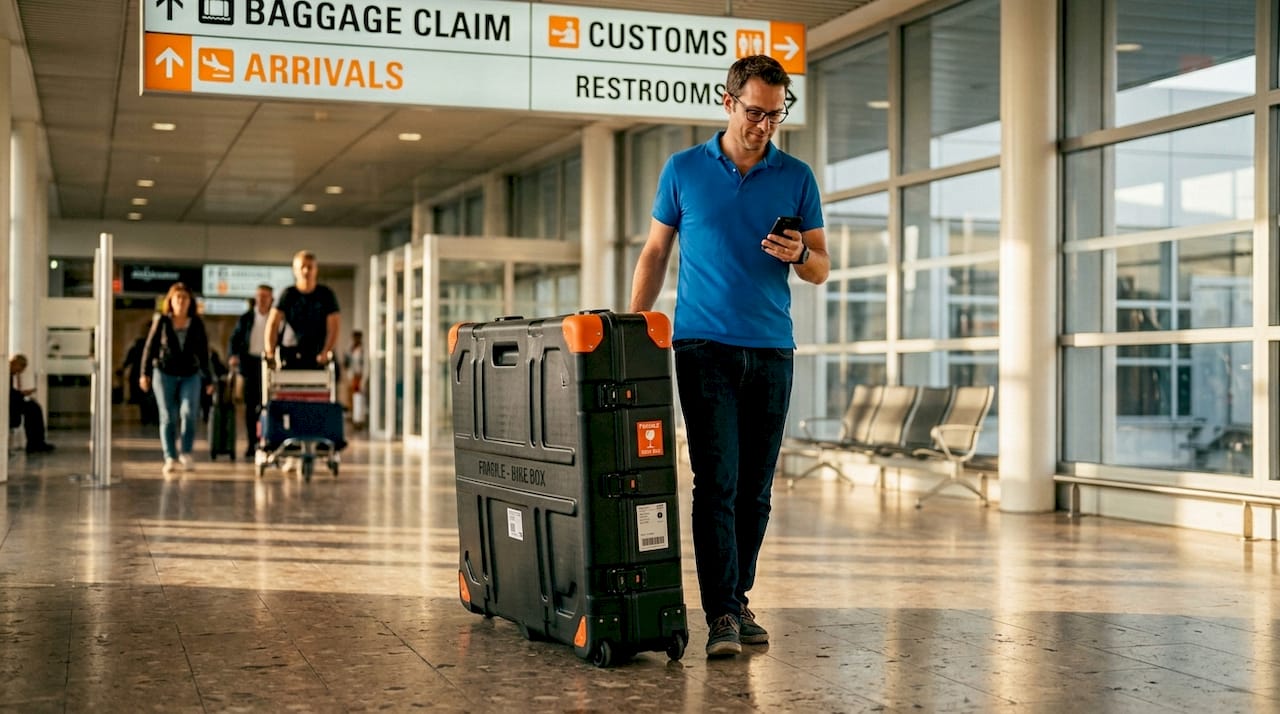
Thousands of traveling cyclists arrive at Nice Côte d’Azur Airport every year with their own bikes, ready to ride legendary coastal stretches and mountain cols that most people only see in race footage. The idea that you need to rent locally or that bringing your own setup is too complicated is simply outdated. With the right preparation around packing, transport, and local services, you can roll off the plane, reassemble your bike, and be climbing toward Col de la Madone within hours of landing. This guide walks you through every step.
Table of Contents
Key Takeaways
Point | Details |
Pack and protect | Use reinforced bike boxes and professional packing for peace of mind during air travel. |
Plan airport transfers | Book van or taxi services in advance to ensure smooth transitions with your bike. |
Explore top routes | The Riviera offers scenic rides for every level, but route and traffic awareness is key. |
Know train rules | French trains have bike-specific restrictions and summer space fills up early—plan bookings ahead. |
Leverage local services | Local mechanics help with unpacking, fit, and emergency repairs so you hit the road worry-free. |
Preparing your bike for the Riviera journey
Getting your bike to the south of France in one piece starts with one decision: what kind of box are you using? Many cyclists underestimate this choice and pay for it with a cracked fork or a bent derailleur hanger.
There are two main options. The first is a reinforced hard-shell or double-walled cardboard bike box, which offers genuine protection against the pressure and rough handling of airline baggage systems. The second is a standard cardboard box, the kind airlines sometimes provide at the check-in counter. Standard boxes are better than nothing, but they offer far less structural protection for carbon frames and precision components.
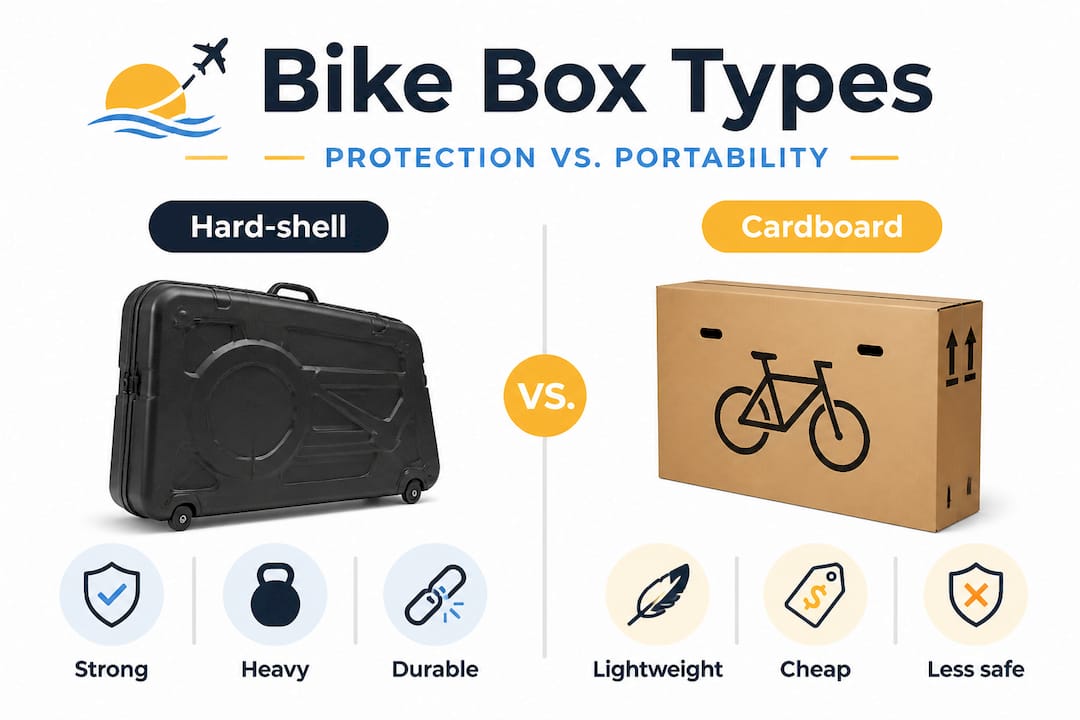
For riders flying into Nice, Riviera Bicycles offers a practical solution. Their reinforced boxes are priced between €65 and €135, and they also offer a professional packing service plus airport van transport for around €65. If you have never packed a bike for flight before, that packing service alone is worth every euro. A single misaligned spacer or improperly taped skewer can cause real damage.
Before you pack, run through this checklist:
Remove both wheels and deflate tires to about 50% pressure to handle cabin pressure changes.
Remove the pedals and turn the left pedal clockwise to loosen (it’s reverse-threaded).
Drop the saddle and seatpost to the minimum insertion mark.
Turn the handlebars 90 degrees and secure them so they don’t pivot.
Wrap the frame, especially the derailleur hanger and fork dropouts, with foam or pipe insulation.
Double-check that your box fits your frame. Most reinforced boxes accommodate frames up to 58cm, which covers the majority of road and gravel builds.
Note that airlines charge bike fees ranging from roughly $30 to $150 each way depending on the carrier, so factor this into your budget alongside box rental and packing. Understanding the private transfer advantages from the airport becomes especially relevant once you realize how awkward it is to navigate public transit with an oversized bike box.
Pro Tip: Book your packing service and airport van pickup at least two weeks in advance, especially during the spring and early summer cycling season when demand spikes fast.
“The single biggest mistake cyclists make is leaving box procurement to the last day. A good box is harder to find than you think, and a bad one costs far more than the rental fee when your frame gets crushed.”
Arriving in Nice: Navigating airports and onward transport
With your bike safely packed, the next step is managing your arrival and local connections across the Riviera. Nice Côte d’Azur Airport is a major international hub, and while it handles bikes regularly, you still need a plan for getting from baggage claim to your accommodation with a box that is roughly 130cm x 80cm x 30cm.
Here is a comparison of your main transport options:
Option | Bike-friendly | Cost estimate | Booking required |
Private van transfer | Yes, ideal | €80-€150 | Yes, in advance |
Taxi (standard) | Limited, small boot | €30-€60 | Sometimes |
Public bus | No, not practical | €1.50-€6 | No |
Train (TER) | Possible if folded | €2-€10 | No |
The clear winner for cyclists with full-size bike boxes is a pre-booked private van. Public buses will not accommodate a bike box under any circumstances. Standard taxis rarely have the trunk space. The train is viable for folding bikes but not for boxed road or mountain bikes.
Once you arrive, a network of local services can handle assembly, fitting, and emergency repairs:
Riviera Bicycles (Nice): professional bikefitting, box rental, and packing services in one place.
CCT Bike Rental (Antibes and Fréjus): Delivery of rental bikes if yours needs emergency replacement.
Cycle Antipolis (Antibes): Full workshop with repairs, parts sourcing, and rental bikes.
Pro Tip: When you book a taxi in Nice or arrange a private van, mention your bike box dimensions at booking. This ensures the right vehicle shows up and you are not left standing at arrivals rearranging logistics on the spot.
Scheduling a hassle-free airport transfer in advance also means your driver monitors your flight in real time. If you land 40 minutes late after a connection delay, your transfer is already adjusted. That kind of reliability matters when you are traveling with expensive equipment and a tight riding schedule.
Exploring iconic Riviera routes: Coast to cols
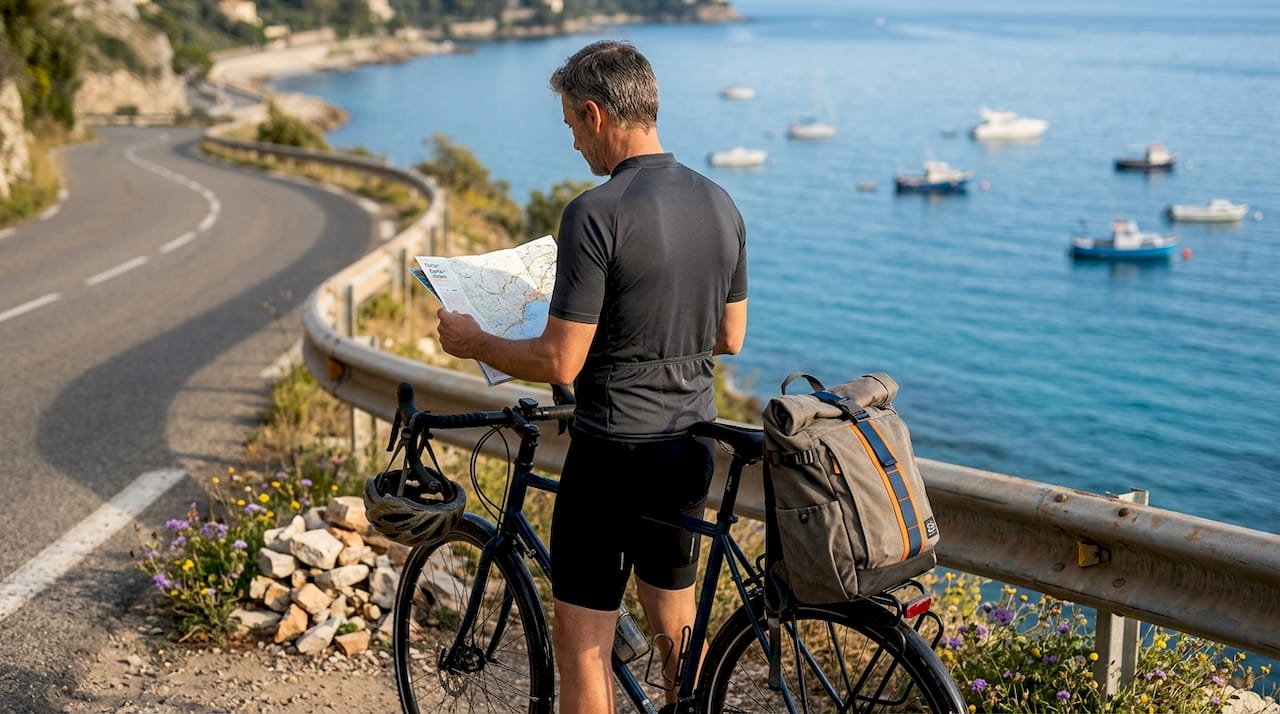
Once you are settled, it is time to choose your first unforgettable Riviera ride. The region offers an almost absurd range of cycling terrain, from flat promenade paths to some of Europe’s most famous climbs.
Here is an overview of the top routes based on distance, elevation, and who they suit:
Route | Distance | Elevation gain | Best for |
Nice-Antibes waterfront path | 25km | Minimal | Beginners, leisure |
Corniche d’Or (Esterel) | 60km | ~1,200m | Intermediate |
Col de Braus loop | 75km | ~1,800m | Advanced |
Col de la Madone loop | 101km | 2,570m | Pro-level fitness |
Col de Turini | Varies | ~1,600m+ | Advanced, club riders |
According to Epic Road Rides, the Corniche d’Or is a 60km coastal route through the Esterel Massif with medium difficulty, making it one of the most rewarding rides for cyclists who want scenery without suffering. The Col de la Madone loop, at 101km and 2,570m of climbing, is where professional teams train before spring classics. Lance Armstrong made it famous. Locals know it as a benchmark climb.
A few things to keep in mind when choosing your routes:
Beginners should start with the waterfront path between Nice and Antibes. It is well-paved, signposted, and almost entirely flat.
Intermediate riders will find the Corniche d’Or and inland backroads around Vence and Grasse genuinely challenging but manageable.
Advanced and club riders should plan their climbing days around the big cols early in the week, when traffic on narrow mountain roads is lighter.
There is very little dedicated cycling infrastructure outside the Nice-Antibes coastal path, so most routes use B and C roads. That means sharing with cars, but the reward is access to village squares, citrus groves, and panoramic views that no bike lane could match. You can find more cycling stories from Nice to help plan your itinerary before you land.
Using trains and public transport with your bike
If your cycling adventure takes you beyond the coast, here is how to bring your bike along on public transport. The French rail network is genuinely useful for cyclists, but it has real rules that catch people off guard.
What is and is not allowed:
“Plan 90 days ahead for TGV; use a bike bag as a reliable backup for any journey where space is uncertain, and always carry tools to disassemble quickly if needed.”
According to Traveler Tips, French trains do not allow tandems, cargo bikes, or recumbent bikes at all. Standard road, gravel, and mountain bikes are fine if the rules are followed.
Here is how to handle each train type:
TER (regional trains): Bikes travel free in designated bike spaces. Spaces are limited, typically four to six per train. No reservation required but no guarantee of space either.
TGV (high-speed trains): Bikes require a paid reservation, currently around €10 per journey. You must book your bike space at the same time as your seat, and these spaces sell out quickly.
Intercités trains: Similar rules to TGV, with paid reservations and limited spaces.
Folded bikes in a bag: A bike disassembled and packed into a bag measuring no more than 120cm x 90cm travels free on all French trains, no reservation needed. This is the most flexible option.
Comparing your main train options:
Train type | Bike fee | Reservation | Space limit |
TER regional | Free | Not required | 4-6 bikes |
TGV | ~€10 | Required | 2-4 bikes |
Bike in bag | Free | Not required | None |
The best strategy for summer travel is to book TGV bike spaces the moment your trip is confirmed, ideally 90 days in advance. If you cannot get a reservation, having a quality bike bag gives you a reliable backup. Understanding private vs taxi transfers is equally useful here, as a private transfer can move you and your bike between train stations or cycling start points without any of the rail space constraints.
Essential dos and don’ts for a seamless Riviera cycling trip
With all the logistics covered, here are the actionable tips that separate a smooth Riviera cycling trip from a frustrating one.
Do:
Book your reinforced bike box, packing service, and airport transport at least two weeks out.
Schedule a professional bikefit with a local service on your first day if you have traveled with your bike boxed and reassembled it yourself. Small saddle height or cleat position errors feel minor but cause real injury over long mountain stages.
Book TGV bike spaces the moment your train tickets are confirmed.
Carry a basic tool kit (hex keys, chain lube, tire levers, two tubes) because remote Riviera roads are not lined with bike shops.
Start with the coastal path to dial in your bike setup before attempting any serious climbing.
Don’t:
Assume a standard airline box is sufficient for a carbon frame. It is not.
Show up at a train station in July expecting a free bike spot on the next TER without planning.
Skip the bikefit because you are in a hurry. One bad fitting decision early in the trip cascades into knee pain by day three.
Ignore local mechanics. Even experienced riders benefit enormously from someone who knows the local roads, the likely puncture zones, and the best emergency bypass routes.
Pro Tip: Train bike spaces sell out fast in summer, especially on routes between Nice, Cannes, and Marseille. If you are traveling with a group, factor in that families or pairs traveling together for group travel often book out entire bike carriages weeks in advance.
A fresh perspective: Why Riviera cycling rewards preparation (and what most guides miss)
Most cycling travel guides give you the route names and a few packing tips, then leave a significant gap between the dream and the reality of actually being there with your bike, a jet-lagged body, and an unassembled frame in a box.
Here is what those guides miss: preparation is not just a logistics exercise, it is your performance strategy. Riders who arrive with a confirmed transport pickup, a pre-booked bikefit, and a clear first-day route plan simply ride better. They are not spending mental energy on logistics anxiety. They are not pedaling with a saddle that is 3mm too low because they rushed the reassembly. They are riding.
The Riviera has a reputation as an elite destination, somewhere for professional teams and wealthy enthusiasts. That reputation puts off a lot of recreational cyclists who would absolutely love the Corniche d’Or or the approach to Col de Braus. The truth is that the region’s cycling is accessible to anyone with moderate fitness and a properly planned trip. The climbs are hard, but they are also finite. The roads are shared, but drivers in this part of France are used to cyclists.
What separates the riders who come home raving from those who come home frustrated is almost never fitness. It is almost always the first 24 hours. A chaotic airport arrival, a bike that takes two hours to reassemble because a critical tool was packed in checked luggage, a missed train connection because nobody checked the bike reservation rules, these are the things that derail trips.
The local logistics in Nice are genuinely well set up for cyclists if you use them intentionally. Local mechanics know the routes. Transfer services know the airport. The infrastructure is there. You just have to plug into it before you leave home, not after you land.
Smooth arrivals: Make your Riviera bike trip effortless
You have done the research, packed the right box, and chosen your routes. The last thing you want is a chaotic arrival that drains your energy before you even clip in.
At nice-airport taxi, we specialize in exactly this kind of transfer. Our vehicles accommodate oversized luggage including bike boxes, and our drivers meet you at arrivals with your flight already tracked. No waiting around, no scrambling for a van that fits your gear. We cover routes from Nice Airport to Cannes, Monaco, Antibes, Saint-Tropez, and destinations across the Riviera. If you prefer to book in French, the French language booking page is available too. Pre-book your transfer, hand off the logistics, and focus entirely on the riding.
Frequently asked questions
Are there bike boxes available at Nice Airport, or should I bring my own?
Nice Airport provides standard bike boxes at check-in, but these offer less protection than reinforced boxes. For carbon frames or precision builds, reinforced bike boxes from local services like Riviera Bicycles are a far safer choice.
Can I bring a tandem or cargo bike on trains along the Riviera?
No. French trains prohibit tandems, cargo bikes, and recumbent bikes entirely. Only standard road, gravel, and mountain bikes are permitted under the applicable rules.
How crowded do bike spaces get on summer trains?
Very crowded. Bike spaces on TGV trains sell out weeks or months in advance during summer. Booking 90 days ahead is strongly recommended for any journey between July and September.
What local services help cyclists after arriving in Nice?
Riviera Bicycles in Nice offers bikefitting, unpacking assistance, and box services. CCT Bike Rental covers Antibes and Fréjus with delivery options, and Cycle Antipolis in Antibes provides a full repair workshop for urgent mechanical needs.
Recommended
Comments